


All That We Carry — Sameer Gudhate on the Stories We Hide Beneath Everyday Life
Some books leave your hands the moment you finish them. Others quietly move into your bloodstream, resurfacing unexpectedly — while waiting at a traffic signal, overhearing strangers argue in a café, or lying awake at 2 a.m. wondering how much of yourself the world has slowly negotiated away.
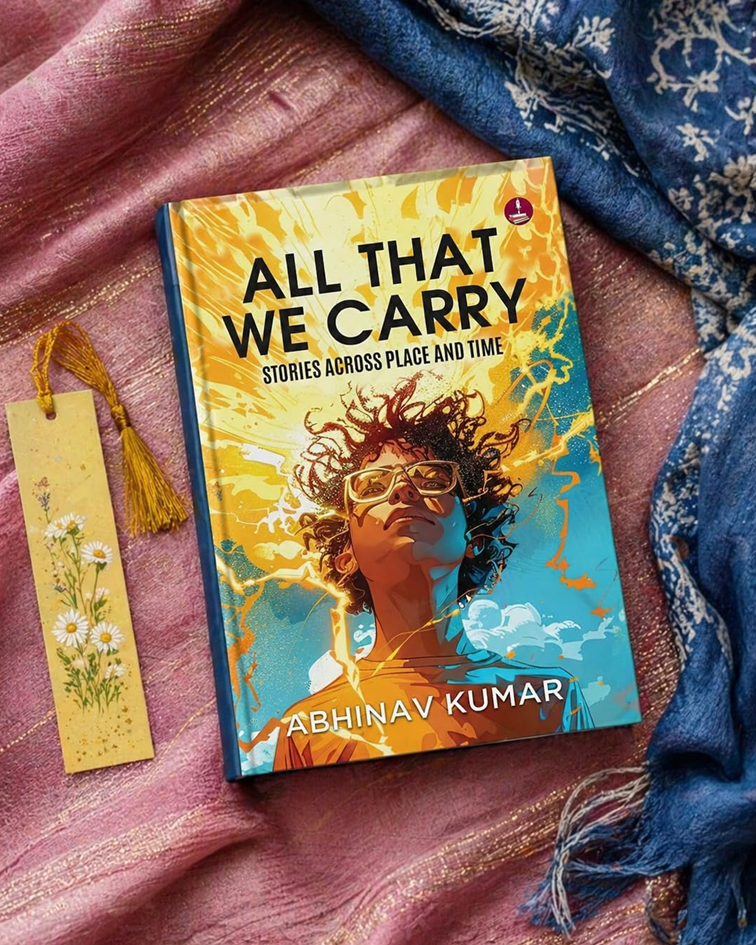
All That We Carry by Abhinav Kumar belongs firmly in the second category.
What stayed with me most was not a dramatic twist or a single unforgettable protagonist. It was the quiet exhaustion running beneath these stories — the exhaustion of constantly negotiating identity in a world that keeps demanding edits to your existence. Sometimes loudly. Sometimes through something as ordinary as a stare in a crowded cab.
One of the earliest images in the collection lingered with me long after I stopped reading: a woman becoming smaller under the weight of everyday gazes. Not violence in the cinematic sense. Something subtler. More familiar. The kind of social scrutiny that slowly erodes a person grain by grain. Abhinav Kumar understands that some of the deepest wounds in modern life are inflicted not through explosions, but through repetition.
That emotional restraint becomes the defining strength of this collection.
These thirteen stories do not scream for attention. They sit quietly beside you and wait for recognition. The prose carries remarkable control — lean, observant, and deeply aware of human silences. There is no unnecessary decoration here. No performative cleverness. Just careful narrative precision that trusts the reader enough to sit inside discomfort without easy resolution.
And honestly, that restraint makes the emotional impact sharper.
While reading, I was repeatedly reminded of conversations overheard in local trains, family gatherings, office corridors, and late-night chai stalls — moments where people reveal fragments of themselves before quickly retreating behind social performance again. These stories capture that exact emotional texture. The characters feel less like “fictional creations” and more like people standing beside us at traffic signals carrying invisible histories.
One particular aspect I admired was how the book moves across different emotional landscapes without losing thematic coherence. Exile. Gender. Communal tension. Memory. Shame. Survival. Migration. Masculinity. Loneliness. The stories travel through all these territories while remaining anchored to one haunting question: what survives after the world repeatedly asks us to compromise who we are?
That thematic consistency is difficult to achieve in short fiction. Many collections feel uneven, as though each story belongs to a different emotional universe. Here, however, the stories speak to one another quietly across pages. Like scattered people making eye contact in a crowded station.
And yet, the book is not emotionally manipulative. That deserves appreciation.
Modern literary fiction sometimes mistakes heaviness for depth. Abhinav Kumar avoids that trap. Even in stories dealing with violence or displacement, there is remarkable emotional discipline. He never overexplains pain. He allows it to breathe. Some readers may even find the understated pacing slightly distant in places, especially if they prefer dramatic emotional payoff or plot-driven storytelling. A few stories end so softly that they almost dissolve rather than conclude. But strangely, that incompleteness feels intentional — because identity itself is unfinished terrain.
There was a moment while reading when I actually paused and shut the book for a few minutes. Not because something shocking happened, but because one line triggered a memory of watching people quietly alter parts of themselves simply to “fit” into professional spaces, social circles, or cities they migrated to. That is the unsettling achievement of this collection. It does not merely tell stories. It activates recognition.
“Sometimes survival is nothing more than learning how to carry your fractured selves without dropping them in public.”
That is the emotional pulse of this book.
The literary prose remains accessible without becoming simplistic. The pacing is patient. The narrative structure trusts silence. And the emotional impact arrives gradually, like monsoon dampness creeping into walls before you fully notice it.
Readers who enjoy reflective, socially aware literary fiction will find much to admire here, especially those who appreciate writers like Jhumpa Lahiri or Alice Munro, where emotional earthquakes happen beneath ordinary conversations. This is not a book meant to be rushed through in a weekend binge. It asks for pauses. For reflection. For emotional participation.
By the end, All That We Carry feels less like a collection of stories and more like a mirror quietly passed from one hand to another.
And perhaps that is what good literature ultimately does — not give us answers, but return us to ourselves with slightly altered eyes.
#AllThatWeCarry #AbhinavKumar #BookReview #IndianLiterature #ShortStories #LiteraryFiction #ReadingCommunity #IdentityAndBelonging #ContemporaryFiction #SameerGudhate #thebookreviewman


Comments