


Finish What You Start by Peter Hollins: Sameer Gudhate Questions the Idea That We Should Never Quit

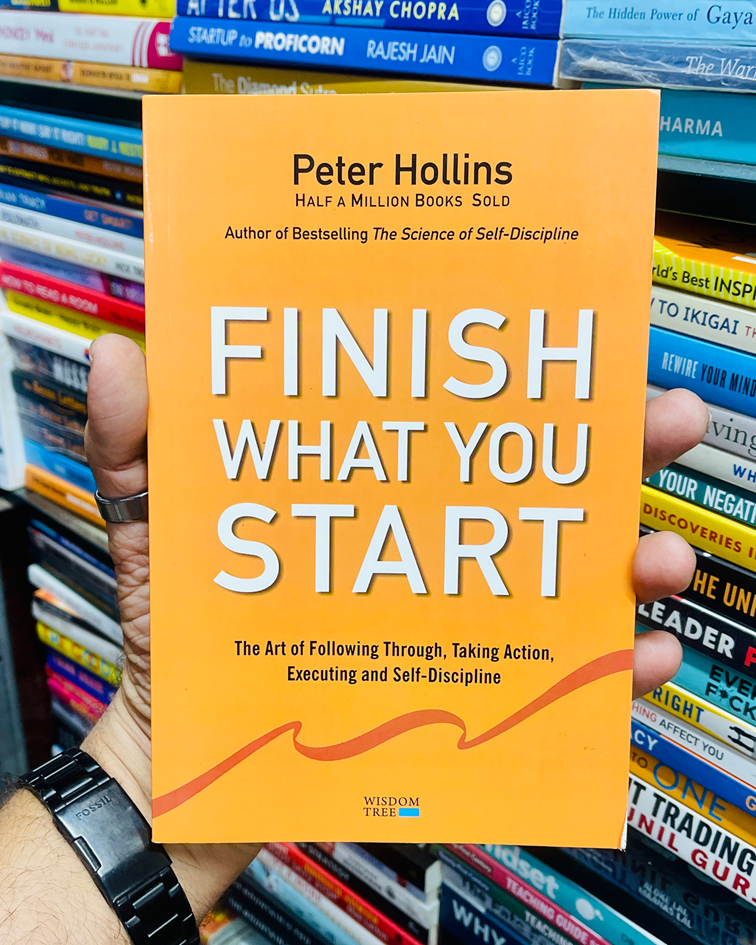
Finish What You Start by Peter Hollins is a practical book about one of the most common problems in modern life: starting things with enthusiasm and then quietly abandoning them.
We make plans. We set goals. We buy books. We begin projects. We promise ourselves that this time we will stay consistent.
Then something happens.
Life gets busy. Motivation disappears. A distraction looks more attractive. The task becomes repetitive. And the unfinished goal slowly moves into the background.
Hollins wants to interrupt that pattern.
But while reading Finish What You Start, I found myself thinking about a question that sits slightly outside the book's central argument:
What if the thing we started was never worth finishing?
That question became increasingly important as I moved through the book.
What Does It Actually Take to Finish Something?
Hollins builds his approach around four elements: focus, self-discipline, action and persistence.
I liked this distinction because discipline is often used as a catch-all word.
Hollins separates the ability to concentrate from the ability to control yourself. He separates taking action from continuing to act after the initial excitement has disappeared.
That last part matters.
Starting is emotionally rewarding.
Finishing usually isn't.
The beginning comes with possibility. The middle comes with repetition.
And somewhere in that middle, we discover whether we genuinely wanted the goal or simply liked the idea of having it.
That is one of the book's most recognisable truths.
Why Do We Stop?
Hollins spends considerable time examining procrastination, distraction and the psychological and behavioural mechanisms that interfere with follow-through.
His discussion of time inconsistency is particularly useful.
We often give more importance to what feels good now than to what may benefit us later. A long-term reward has to compete with a very immediate temptation.
That explains something we often describe too casually as a lack of discipline.
Sometimes the problem isn't that we don't know what to do.
We simply don't want to do it now.
That is a very different problem.
Hollins responds with practical strategies: breaking large tasks into smaller actions, reducing distractions, batching similar activities, limiting the number of important tasks in a day, creating personal rules and using short delays to resist immediate temptation.
He also argues for building systems rather than depending entirely on willpower.
That is one of the more useful aspects of the book.
Instead of asking ourselves every morning whether we feel like doing something, we can create an environment in which the desired behaviour becomes easier to repeat.
The Problem With the Advice
There is, however, a limitation.
Much of what Hollins discusses has already been explored in books about productivity, habits, procrastination and self-discipline.
The ideas are useful, but readers who have spent considerable time in this category may occasionally feel that they have encountered some of these arguments before.
That doesn't make them useless.
Sometimes we don't need another discovery.
We need a better reminder.
The book's discussion of a personal manifesto interested me for precisely this reason.
Hollins suggests creating a set of rules that can guide behaviour when motivation disappears.
There is something practical about this.
Motivation changes with circumstances. A personal rule doesn't have to feel inspiring. It simply has to provide direction when motivation isn't available.
But this is also where I began pushing back against the book.
Is Every Unfinished Goal a Failure?
Hollins's framework can sometimes make failure to follow through sound like a problem of laziness, weak discipline or poor choices.
Human behaviour is rarely that simple.
People abandon things for many reasons.
Sometimes they are afraid.
Sometimes they are distracted.
Sometimes they have taken on too much.
Sometimes circumstances change.
And sometimes they discover that the thing they were pursuing is no longer what they want.
That last possibility deserves more attention.
There is a difference between quitting because something became difficult and stopping because continuing no longer makes sense.
From the outside, both can look like giving up.
They aren't necessarily the same.
Persistence Is Not the Same as Progress
This distinction also made me think about the relationship between persistence and progress.
Repeating an action for a long time does not prove that the action is taking us somewhere useful.
We can become extraordinarily disciplined at doing the wrong thing.
That doesn't make persistence meaningless.
It makes judgment part of persistence.
For me, this is where Finish What You Start becomes more interesting than its title suggests.
Following through is not simply the ability to keep going.
It is the ability to keep going after the excitement has left.
That is a much harder test.
Anyone can make a promise to their future self.
The difficult part is honouring that promise when the future becomes the present and the work becomes repetitive.
Systems Over Willpower
This is perhaps the part of Hollins's thinking I found most practical.
Willpower asks:
Can I force myself to do this?
A system asks:
How can I make doing this less dependent on how I feel today?
That is a more sustainable question.
Hollins is at his best when he moves in this direction. His methods are straightforward and easy to revisit. He isn't trying to turn follow-through into an abstract philosophy. He wants readers to translate intention into behaviour.
But the book becomes less convincing when the answer seems to be simply becoming tougher.
Sometimes toughness is exactly what we need.
Sometimes judgment is.
The difficult part is knowing which one the moment demands.
The Question I Was Left With
That is why I finished Finish What You Start thinking about something slightly different from what the title initially suggests.
Is finishing everything we start a sign of discipline, or is knowing what deserves to be finished the deeper form of discipline?
Perhaps real self-discipline isn't merely refusing to quit.
Perhaps it is learning to distinguish between an obstacle that should be overcome and a destination that should be abandoned.
That distinction can determine whether persistence becomes progress or merely repetition.
And that, for me, is the more interesting conversation Peter Hollins's book opens.



Comments