


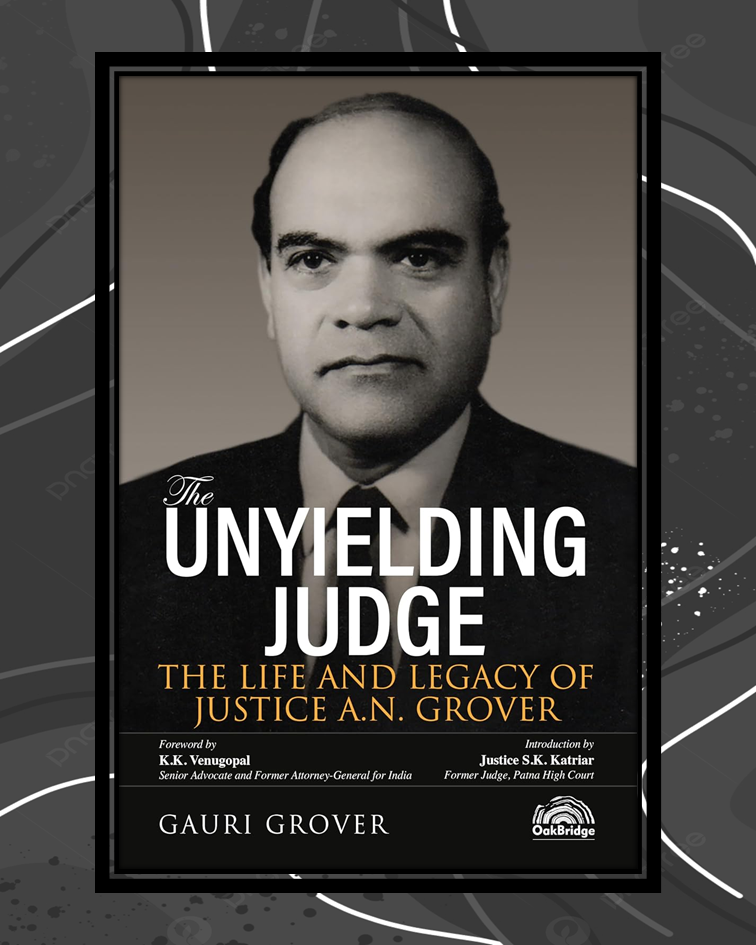
The Unyielding Judge by Gauri Grover: When Principles Come at a Cost

Some biographies tell you what a person accomplished.
A few make you wonder what that person was willing to lose along the way.
That was the thought I kept returning to while reading The Unyielding Judge by Gauri Grover, a book about her grandfather, Justice A.N. Grover.
I began the book expecting to encounter a distinguished judge and an important chapter in India's constitutional history. I did. But somewhere along the way, the book became less about the position Justice Grover occupied and more about the principles he chose to hold on to when those principles had consequences.
And that is a much more uncomfortable question.
More than a judicial biography
Gauri Grover could have written a conventional account of her grandfather's professional life.
There was certainly enough material.
A distinguished legal career. His contribution to Indian constitutional law. His place in the history surrounding the Basic Structure Doctrine. The episode of judicial supersession.
His later association with education and the Press Council of India.
But The Unyielding Judge does not remain confined to a list of appointments, judgments and achievements.
The personal connection between author and subject changes the texture of the book.
Justice Grover is not presented only as a judge whose name appears in legal history. He also appears as a grandfather, a family member and a person whose professional values seem to have grown out of a much longer journey.
That matters.
Because values rarely arrive fully formed on the day someone takes an oath.
Where do principles come from?
The sections dealing with Justice Grover's early life and education are important for precisely this reason.
They help establish the person before the institution.
His years as a lawyer then show how those values entered professional life. Later, his judicial career demonstrates what happens when personal convictions encounter institutions, authority and difficult choices.
This is particularly relevant when the book enters the complicated history around the Basic Structure Doctrine.
Constitutional history can become very dry very quickly.
Names.
Cases.
Dates.
Doctrines.
Legal terminology.
But underneath all of that is a very human question:
What does institutional independence actually demand from the person inside the institution?
That question gives the historical material a different weight.
The cost of standing firm
The episode of judicial supersession is where the book's central idea becomes difficult to avoid.
There is a difference between holding a position and holding a principle.
A position can be offered.
It can be withdrawn.
It can be elevated.
It can be denied.
A principle is different.
A principle becomes meaningful precisely when keeping it is inconvenient.
That is what stayed with me.
We often speak about integrity as though it is a personality trait, something a person simply possesses. But real integrity is tested when the easier option is available.
It is easy to admire someone after history has settled the argument.
It is harder to imagine what that decision felt like before the outcome was known.
What happens when standing by what you believe may affect your career?
What happens when silence is safer?
What happens when compromise would make life considerably easier?
Those questions make Justice A.N. Grover's story relevant beyond the courtroom.
The man beyond the judge
Another aspect I appreciated is that the book does not stop at the Supreme Court.
Justice Grover's association with education through the Delhi Public School Society and his work with the Press Council of India expand the portrait.
His public life did not begin and end with the judiciary.
That is worth remembering.
We tend to put people into professional boxes.
Judge.
Lawyer.
Educationist.
Public servant.
But people do not actually live that way.
The values that shape a person in one part of life often follow them into another.
The courtroom may reveal what a person decided.
A different public role may reveal why service mattered to them in the first place.
A granddaughter's perspective
There is another layer here that cannot be separated from the book.
Gauri Grover is writing about her grandfather.
That inevitably brings affection into the narrative.
Normally, that could create a distance from the historical figure. A family member may see the person so closely that the public record becomes secondary.
But here, the relationship adds another dimension.
We see Justice Grover as a historical figure.
We also get glimpses of the man who remained a grandfather.
And that creates a fascinating question for the reader:
When someone you love becomes part of history, how do you preserve the person without losing sight of the historical figure?
The answer seems to be found in the book's movement between the personal and the institutional.
The courtroom tells us what Justice Grover did.
The historical context tells us why some of those decisions mattered.
The family perspective reminds us that the person behind those decisions was not merely a name in a law book.
Why this book stayed with me
I don't think The Unyielding Judge is a book to approach as a light, quick biography.
Some of its strongest sections require attention because the period of Indian
constitutional and judicial history it explores is complex.
But that complexity is also what gives the book its relevance.
By the end, I wasn't thinking only about judges.
I was thinking about myself.
About the small compromises people make every day.
About the difference between what we say we believe and what we are prepared to
stand by when there is something to lose.
Because integrity sounds very simple when there is no price attached to it.
The real test begins when there is.
And perhaps that is what The Unyielding Judge ultimately leaves behind.
Not a simple lesson.
Not an easy answer.
Just a question that becomes increasingly difficult to ignore:
When circumstances ask us to compromise, how much of ourselves are we willing to give up to make life easier?
Justice A.N. Grover's story does not make that question easier.
It makes it harder to avoid.
The Unyielding Judge by Gauri Grover is therefore not merely a biography of a judge. It is an examination of principle, consequence, public responsibility and the human being behind an important chapter of India's judicial history.



Comments