


When Justice Failed, Fear Ruled: A Review of The Shadow of Evil by Jigs Ashar & Sarthak Dasgupta — By Sameer Gudhate

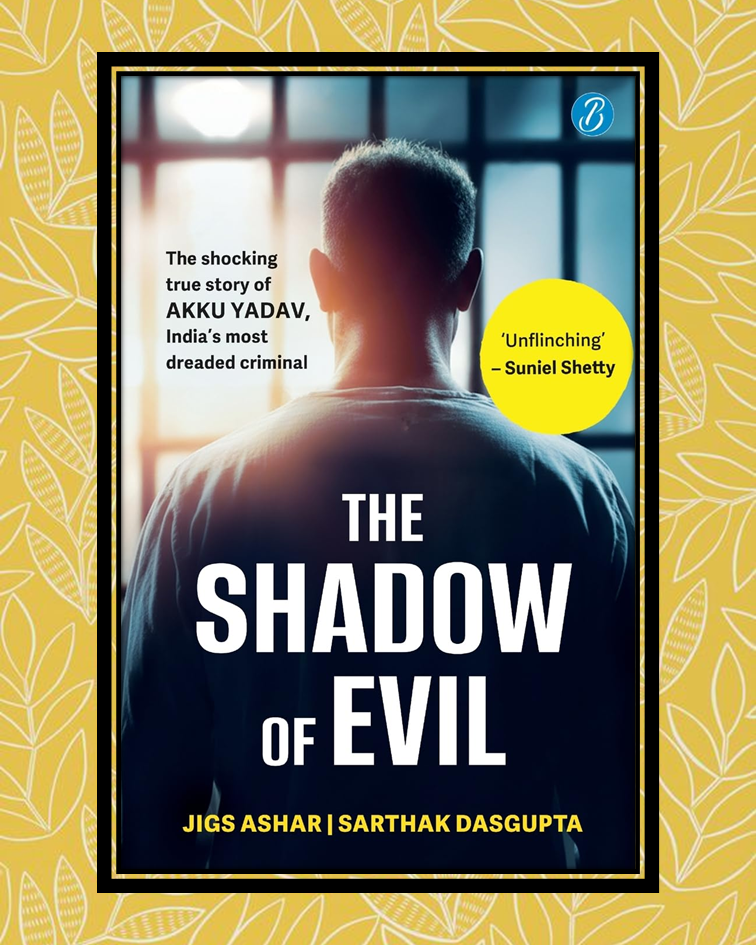
There are crimes so brutal that they refuse to remain inside police files. They become part of a city's memory. Parents whisper about them to protect their children. Entire neighbourhoods measure time by what happened before and after. The Shadow of Evil belongs to that unsettling category of true crime—not because it glorifies violence, but because it forces us to confront what happens when violence becomes ordinary.
At first glance, this appears to be the story of one man.
It isn't.
Akku Yadav is certainly the centre of the narrative, but the book is far more interested in the ecosystem that allowed him to exist. Fear rarely survives on its own. It feeds on silence, corruption, indifference and the quiet calculations of people who decide that looking away is safer than speaking up.
That is the real antagonist here.
Jigs Ashar and Sarthak Dasgupta approach the subject less like sensationalists and more like patient chroniclers. They reconstruct years of terror with restraint, allowing documented events to carry their own emotional weight. They understand something many true-crime writers often forget: facts become far more disturbing when they are not exaggerated.
The result is a narrative that unsettles without needing theatrical language.
The descriptions of life inside Kasturba Nagar reveal something larger than a criminal biography. They show what daily existence becomes when fear is no longer an interruption but a routine. When stepping outside your house, sending your daughter to school, or simply refusing a criminal's demand can carry unimaginable consequences, survival itself becomes an exhausting full-time occupation.
That quiet psychological suffocation is what the book captures best.
Interestingly, Akku Yadav almost begins to feel less like an individual and more like a symbol. His brutality is horrifying, but even more disturbing is how predictable it becomes. Every new crime raises the same uncomfortable question: where are the institutions that are supposed to stop this?
The answer is what gives the book its emotional force.
Again and again, the narrative points toward systemic failure. Corrupt policing. Political convenience. Administrative paralysis. The story repeatedly reminds us that monsters rarely become powerful in isolation. They grow in the spaces where accountability disappears.
That broader perspective elevates the book beyond conventional true crime.
Yet the authors never allow institutions to completely dominate the narrative. They keep returning to ordinary people.
A lawyer.
A banker.
A bar owner.
A young working woman.
None of them resemble cinematic heroes. None possess extraordinary power. Their courage feels believable precisely because it emerges from exhaustion rather than fearlessness. They are not driven by revenge alone. They are driven by the unbearable realization that continuing to remain silent is no longer an option.
That emotional progression feels authentic.
Perhaps the book's greatest achievement is the way it shifts the reader's attention.
Initially, curiosity naturally centres on the criminal.
Gradually, however, that curiosity gives way to admiration for the people who refused to surrender their humanity despite years of intimidation. By the later chapters, Akku Yadav almost becomes secondary. The emotional core belongs to the women whose resilience slowly transforms fear into collective resistance.
The title speaks of evil.
The lasting memory is courage.
From a structural standpoint, the writing favours accessibility over literary flourish. The language is deliberately straightforward, the chapters move quickly, and the pacing rarely lingers longer than necessary. This makes the book surprisingly easy to read despite its deeply disturbing subject matter. That simplicity serves the narrative well because ornate prose would have risked distracting from the events themselves.
At the same time, this restraint occasionally becomes a limitation.
Some moments seem to rush past emotional turning points that deserve greater reflection. The investigative details remain engaging, but there are places where the psychological aftermath for survivors feels only briefly explored. Considering the extraordinary resilience displayed by the community, spending more time inside those emotional landscapes could have given the narrative even greater depth.
Similarly, readers looking for broader sociological analysis of gendered violence, institutional collapse or vigilante justice may find themselves wanting slightly more context. The book prioritizes momentum, and while that keeps the pages turning, it sometimes leaves larger ethical questions hanging in the background rather than examining them in full.
Even so, those omissions never diminish the gravity of what unfolds.
What ultimately distinguishes The Shadow of Evil from many books in the genre is its refusal to romanticize either violence or justice. There are no triumphant victories here. No clean endings. Only ordinary people pushed so relentlessly toward the edge that the boundaries between justice, desperation and survival begin to blur.
That moral discomfort lingers.
Long after the names fade, one question remains impossible to ignore.
How many people have to lose faith in the system before they decide the system no longer deserves their faith?
That question extends far beyond Nagpur. It belongs to every society that believes institutions are strong enough to protect the vulnerable—until one day they don't. And it is in that uneasy space, between law and abandonment, that The Shadow of Evil leaves its deepest shadow.



Comments