


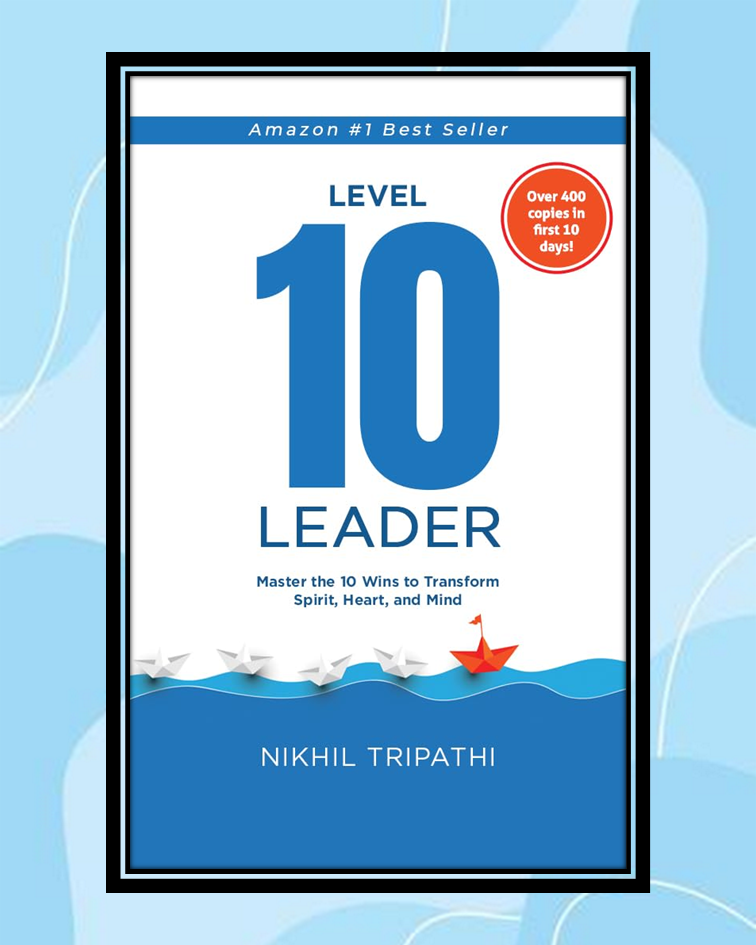
Why Leadership Begins Where Control Ends. Sameer Gudhate reviews Level 10 Leader by Nikhil Tripathi

Most careers prepare people to do the work. Very few prepare them for the moment when their success depends on helping others do it.
That gap sits at the heart of Nikhil Tripathi's Level 10 Leader. It is a gap familiar to anyone who has watched a high-performing individual contributor become a manager overnight and discover that competence and leadership are not interchangeable skills. The promotion arrives with applause. The confusion arrives quietly afterward.
What makes this book interesting is that it refuses to treat leadership as a collection of techniques. Instead, it approaches leadership as a series of tensions that never fully disappear. The newly promoted manager Sarah becomes the vehicle through which Tripathi explores these tensions, not as abstract theories but as lived experiences. Confidence competes with humility. Authority competes with empathy. Results compete with relationships. Growth competes with security.
In many workplaces today, promotion remains one of the least examined transitions in professional life. Organizations spend enormous resources evaluating performance but surprisingly little helping people navigate the psychological shift from individual achievement to collective responsibility. The book enters precisely at that point of uncertainty.
What stayed with me was not any single framework but the author's recognition that leadership often feels like standing between competing expectations. A manager must satisfy senior leadership while earning the trust of a team. They must provide direction without becoming controlling. They must remain accountable for outcomes they can no longer directly produce themselves. Leadership, the book suggests, is less about finding perfect answers than learning to navigate permanent contradictions.
Tripathi organizes these challenges through what he calls the "10 Wins," divided across Spirit, Heart, and Mind. It is a structure that could easily have become formulaic. Instead, it serves as a reminder that leadership is not purely strategic or operational. People follow competence, but they remain committed to purpose, trust, and emotional credibility.
The strongest idea in the book emerges from this integration. Many leadership books focus heavily on what leaders do. Level 10 Leader repeatedly returns to who leaders become. That distinction matters. Processes can be copied. Spreadsheets can be replicated. Authority can be assigned. Character cannot.
I was particularly drawn to the emphasis on delegation and coaching. In practice, these are among the most misunderstood aspects of management. New managers often cling to tasks because completing them themselves feels safer than trusting others. Yet the very behaviour that once made them successful becomes a limitation at the next level. Growth often begins where personal control ends.
The BHAG Roadmap framework illustrates this practical side effectively. Large ambitions are translated into smaller milestones measured over weeks, months, and quarters. It is hardly a revolutionary concept, but its strength lies in making progress visible. Grand goals frequently fail not because they are unrealistic but because they remain emotionally distant. Breaking them into manageable intervals transforms aspiration into action.
The book's greatest strength is accessibility. Corporate leadership literature frequently hides simple ideas beneath layers of jargon. Tripathi chooses the opposite route. His language is direct, conversational, and intentionally approachable. Readers encountering leadership concepts for the first time are unlikely to feel intimidated.
Yet that accessibility occasionally creates its own limitation. Some of the paradoxes and solutions are presented with a confidence that reality does not always permit. Leadership challenges are often shaped by organizational politics, dysfunctional cultures, economic pressures, and conflicting incentives. Not every dilemma yields to self-awareness or better communication. Experienced leaders may occasionally wish the book spent more time exploring situations where good leadership still produces imperfect outcomes.
This tension reflects a broader question about leadership literature itself. Should such books simplify complexity in order to help readers act, or should they embrace complexity even at the risk of overwhelming them? Tripathi largely chooses action over ambiguity. For many emerging managers, that is probably the correct choice. But it does mean certain messy realities remain at the edge of the conversation rather than its centre.
The book arrives at a time when work itself is being redefined. Hybrid teams, digital communication, constant connectivity, and shifting expectations have changed the nature of management. Technical expertise remains valuable, but increasingly the differentiating skills are human ones: listening, coaching, trust-building, feedback, and purpose. In that sense, Level 10 Leader speaks directly to a contemporary workplace challenge. Technology continues to accelerate, while leadership remains stubbornly human.
The most enduring idea in Level 10 Leader is not found in a chart or a framework. It lies in the recognition that leadership begins when success is no longer measured by what you can accomplish yourself. The moment responsibility shifts from personal achievement to collective growth, the real work starts.
#Level10Leader #NikhilTripathi #LeadershipDevelopment #NewManagers #LeadershipParadoxes #PeopleLeadership #ManagementSkills #WorkplaceGrowth #BusinessBookReview #SameerGudhateReads



Comments