


I Hate Mathematics. This Book Made Me Respect It. — Sameer Gudhate Reflects on Cédric Villani's Birth of a Theorem

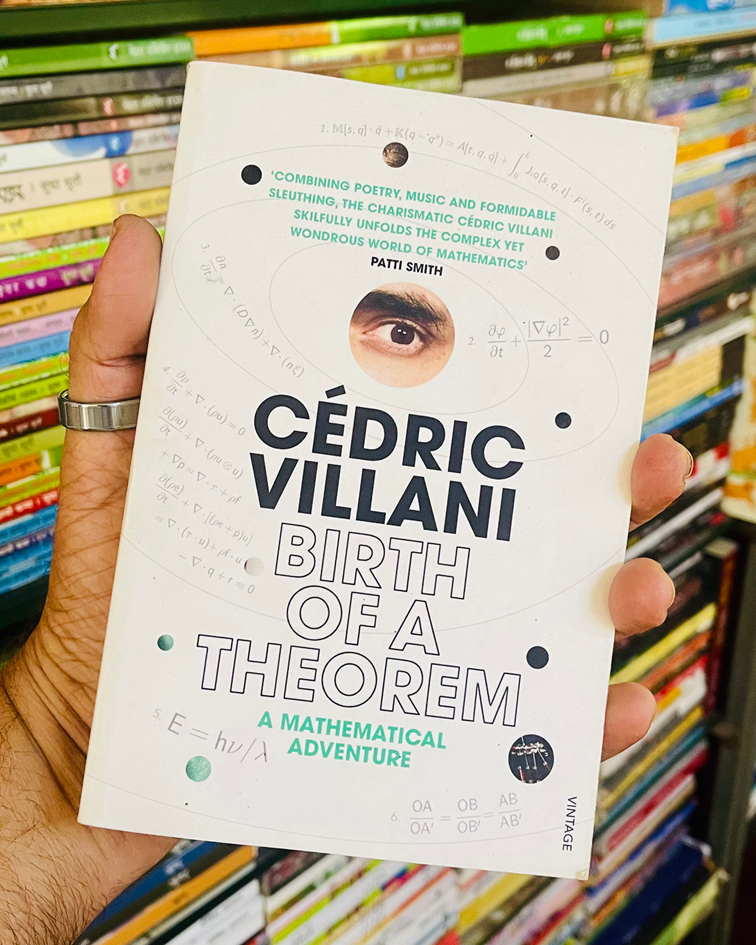
Every time Sheldon Cooper appeared on The Big Bang Theory, I'd laugh at how someone could become so consumed by equations that the rest of the world seemed like background noise. I'd enjoy the jokes, shake my head, and think, "Thank goodness I'm not a mathematician."
The truth is, I hate mathematics.
I always have.
If you asked me to choose between solving an equation and reading a history book, I'd reach for the history book before you finished the question. So, when I picked up Cédric Villani's Birth of a Theorem, I wasn't expecting to enjoy it. I certainly wasn't expecting it to change the way I looked at mathematicians.
It didn't make me love mathematics.
It made me understand obsession.
Villani doesn't write about numbers as much as he writes about what it costs to pursue an idea that refuses to leave you alone. His theorem becomes less a mathematical destination than a companion that follows him through airports, conferences, family dinners, sleepless nights, and long conversations with fellow researchers. The equations are there, often in intimidating detail, but they are only the visible language of a much deeper story—the relentless pursuit of something that may not even exist.
That is what makes this memoir so distinctive. Rather than simplifying his celebrated work on the Boltzmann equation and Landau damping for a general audience, Villani chooses honesty over accessibility. He trusts the reader enough not to dilute the complexity. It is an admirable decision, though not an entirely welcoming one.
There were pages where I felt completely lost. The advanced mathematics often sailed far beyond my understanding, and I suspect many readers without a professional background will experience the same frustration. At times, the book asks for more mathematical literacy than curiosity alone can provide. It is a limitation worth acknowledging because it inevitably narrows its audience.
Yet something unexpected happens when you stop trying to understand every equation.
You begin to understand the person writing them.
Slowly, the memoir transforms from a book about mathematics into one about perseverance. Conferences become laboratories of shared ideas. Emails carry breakthroughs as often as disappointments. Collaborators challenge, encourage and rescue one another. Villani's relationship with Clément Mouhot quietly dismantles the romantic image of the lone genius. Great discoveries, this book reminds us, are often conversations stretched across years.
Its portraits of mathematical giants deepen that conversation. John Nash appears not simply as an icon but as an intellectual influence whose work echoes through Villani's own journey. Einstein, Gödel and others emerge not as distant legends but as fellow travellers in humanity's endless attempt to understand patterns hidden beneath reality.
What lingered with me most, however, was not the mathematics but the rhythm of research itself. We live in a culture that celebrates results and hides the process. Social media shows medals, published papers, bestselling books and finished products. Rarely do we see the discarded drafts, failed experiments or abandoned ideas that made them possible. Birth of a Theorem lives almost entirely inside that invisible space.
There are moments when the memoir becomes fragmented, wandering into historical detours that interrupt its emotional momentum. Readers searching for a clearer narrative may occasionally lose their footing. Ironically, the book sometimes mirrors mathematical research itself—brilliant, demanding, occasionally meandering, and rewarding only those willing to stay with it.
Perhaps that is its greatest achievement. It never tries to convince you that mathematics is easy or glamorous. Instead, it quietly reveals that genuine discovery—whether in mathematics, music, literature or sport—is built on countless ordinary days when nothing seems to happen except the decision to continue.
I still hate mathematics.
But I closed this book with immense respect for the people who willingly spend years wrestling with questions most of us would never even think to ask.
Sometimes a book doesn't change your opinion of a subject.
It changes your opinion of the people who devote their lives to it. And that may be the more meaningful theorem of all.


Comments