


Sameer Gudhate Explores Urmila: The Forgotten Sacrifice That Sustained a Legend
For every epic hero history remembers, there is usually another life standing just outside the spotlight. Not absent. Not insignificant. Simply overlooked.
Few literary traditions illustrate this more clearly than the Ramayana. Generations have reflected on Rama's duty, Sita's endurance, and Lakshmana's devotion. Yet one question lingers quietly in the background: what happens to the person who is left behind while others become legends?
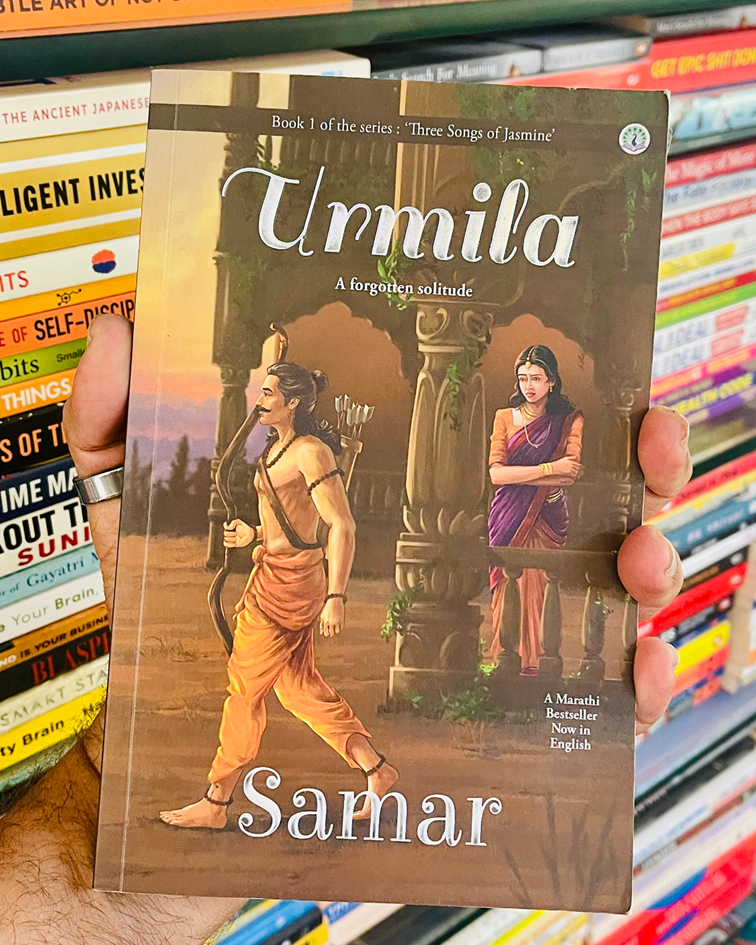
Samar's Urmila is built around that question. Rather than retelling the Ramayana through battles, divine interventions, or royal intrigue, the novel turns its attention toward absence itself. It asks readers to inhabit the emotional landscape of Urmila, Lakshmana's wife, whose fourteen years of separation become not merely a narrative detail but an entire human existence worthy of examination.
What surprised me most was not that Urmila suffers. Mythological retellings often rely on suffering as a shortcut to sympathy. Samar chooses a more demanding route. He is interested in how a person continues living when life refuses to follow the script they imagined for themselves. The novel follows Urmila from her childhood in Mithila through marriage, separation, motherhood, ageing, and eventually her role as a matriarch. In doing so, it transforms a marginal figure into the emotional centre of an epic world.
The strongest achievement of the novel lies in its refusal to reduce Urmila to sacrifice alone. Modern readers are familiar with public recognition. Social media rewards visibility. Success is measured through attention. Yet much of human life unfolds without witnesses. Parents make sacrifices their children may never fully understand. Spouses carry burdens that remain unnamed. Caregivers devote years to others while receiving little acknowledgment in return. Urmila becomes a symbol of these invisible lives.
One of the novel's most compelling insights is that loneliness and insignificance are not the same thing. A person can be forgotten by history and still profoundly shape it. Urmila's isolation in Ayodhya is not portrayed merely as waiting. It becomes a test of identity. When the person around whom one's future was imagined suddenly disappears, who remains?
That question gives the novel contemporary relevance. We live in an era obsessed with presence—online presence, professional presence, public presence. Yet emotional absence has become increasingly common. Long-distance relationships, migrant families, demanding careers, and digital communication have created new forms of separation. Samar's interpretation of Urmila speaks to readers navigating similar emotional distances, even if the circumstances are vastly different.
The novel is at its strongest when it explores interior experience. The emotional rhythms of longing, uncertainty, resentment, hope, and endurance feel convincing because they emerge gradually rather than dramatically. Readers are invited to sit with Urmila's solitude instead of merely observing it from a distance. That patience gives the narrative much of its emotional credibility.
At the same time, the book occasionally reveals the limitations that accompany its ambitions. Because Samar seeks to provide a comprehensive account of Urmila's life—from birth to death—the narrative sometimes prioritizes completeness over depth. Certain later-life episodes feel more documented than fully explored. There are moments when readers may wish the novel lingered longer within psychological complexity instead of moving forward chronologically. The desire to illuminate every phase of Urmila's journey occasionally dilutes the intensity found in its most intimate sections.
There is also an interesting tension at the heart of the novel. In its effort to restore Urmila's importance, the narrative sometimes risks idealizing her. Real people are rarely as coherent as legends. A little more ambiguity, contradiction, or emotional messiness might have made her feel even more human. Yet this criticism emerges largely because the novel succeeds in making readers care about her inner life in the first place.
What stayed with me long after finishing the book was not a particular event but a realization. Epics often celebrate those who leave home to fulfill destiny. Urmila quietly honours those who remain behind and pay the emotional cost of that destiny.
That distinction matters.
History tends to record journeys. Life, however, is often shaped by waiting.
The achievement of Urmila is not that it changes the Ramayana. The achievement is that after finishing the novel, it becomes difficult to read the epic again without noticing the empty space Urmila once occupied—and impossible to believe that space was ever empty at all. Samar reminds us that every celebrated act of devotion is sustained by someone whose story rarely reaches the centre of the stage. By giving voice to that silence, he transforms a forgotten presence into one of the most human and memorable figures in the epic imagination.
#Urmila #Samar #RamayanaRetelling #MythologicalFiction #MarathiLiterature #IndianMythology #ForgottenVoices #LiteraryFiction #BookReview #ReadingCommunity #sameergudhate #thebookreviewman


Comments