


Sameer Gudhate Presents the Book Review of You Can Automate by Samar Mandke

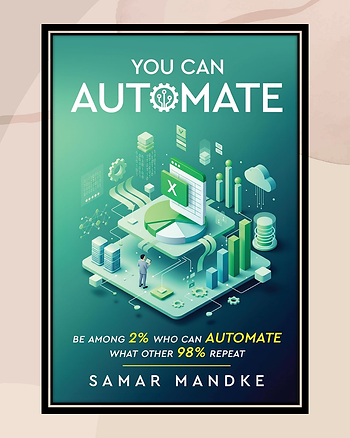
Some books arrive like a loud knock on your desk. This one arrived as a pause. I was mid-task—cells copied, formulas dragged, the quiet hum of routine—and suddenly I found myself stopping, not because Excel failed, but because I was being watched. Or rather, my habits were. You Can Automate doesn’t barge into your workflow with instructions. It leans in and asks, gently but firmly, why you are still doing this by hand.
Samar Mandke doesn’t write like an instructor standing at a whiteboard. He writes like someone who has sat beside you for years, noticed your shortcuts, your workarounds, your silent acceptance of repetition. The book positions itself as Excel automation, VBA, logic, templates—and it is all of that—but what lingers is its narrative voice. There’s a mentoring quality here, a steady insistence that competence without reflection is just another loop.
The premise is simple and quietly radical: most of us repeat what could be designed. The book doesn’t dramatize this with grand claims; it demonstrates it through practical situations that feel uncomfortably familiar. HR trackers, finance sheets, operational dashboards—scenes from everyday professional life. Instead of overwhelming theory, the prose moves with purpose. Each idea arrives because it needs to. Each concept answers a question you didn’t realize you were already asking: how would I automate this?
What struck me most was the emphasis on thinking before typing. VBA here isn’t treated as syntax to be memorized, but as a language of logic. Error handling becomes less about avoiding failure and more about respecting reality. Modular design isn’t presented as best practice jargon, but as a way of building tools that survive beyond you. The pacing mirrors this philosophy—measured, accumulative, patient. Insight builds the way good habits do: slowly, through repetition that finally earns meaning.
There’s a moment, recurring through the book, where diagrams and practice sets invite you to pause and test your understanding. These aren’t decorative. They’re sticky. I found myself returning to them, not to revise, but to recalibrate how I approach problems. That reread value gives the book its functional strength. It isn’t consumed; it’s consulted. The narrative may be instructional, but the impact is reflective.
What elevates the book beyond a manual is how it reframes repetition as a theme rather than a flaw. Repetition, Mandke suggests implicitly, is a choice we normalize. Each copied step is a small act of surrender. That idea landed harder than any code snippet. I began noticing my own routines—the ones I’d justified as efficiency. The book doesn’t shame these habits. It exposes them. That exposure is where transformation begins.
Structurally, the book balances clarity with ambition. There’s an interview-oriented lens woven through the chapters, preparing readers not just to answer questions, but to demonstrate reasoning. Mini projects ground the learning in workplace reality, while the larger arc points toward career visibility and problem-solving credibility. At times, the enthusiasm in the framing can feel a touch insistent, but it never undermines the core value: the material works because it’s been lived.
Emotionally, my reading journey was marked by small, surprising pauses. Not delight in the traditional sense, but recognition. A quiet discomfort that felt useful. By the end, the book felt intentionally unfinished. Not because it lacks content, but because it hands responsibility back to the reader. Automation here is not an endpoint; it’s a mindset shift. The story continues every time you hesitate before repeating a task.
This book will resonate deeply with professionals in finance, HR, operations—anyone drowning in spreadsheets and deadlines—but also with readers who enjoy seeing tools treated with literary seriousness. It’s best read at a desk, mid-workday, when irritation is fresh. That’s where its impact multiplies.
I closed the book with the sense that Excel hadn’t changed. I had. Every repeated action now feels like the opening line of a narrative I can either copy or redesign. That choice, once seen, can’t be unseen.


Comments