


The World Behind a 10-Minute Delivery: Reflections on Buildit by Albinder Singh Dhindsa | Reviewed by Sameer Gudhate

There is a peculiar modern habit that most of us participate in without thinking about it. We tap a screen, place an order, and begin measuring time in minutes. A packet of biscuits, a bottle of medicine, a charger, even an iPhone appears at the doorstep so quickly that the machinery behind the experience becomes invisible. Convenience has become so ordinary that we rarely ask what it takes to manufacture it.
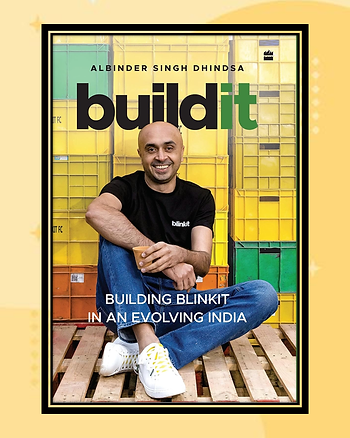
That question sits at the heart of Buildit: Building Blinkit in an Evolving India, Albinder Singh Dhindsa’s account of creating one of India’s most recognizable quick-commerce companies. Yet what makes the book interesting is not the eventual success of Blinkit. It is the portrait of uncertainty that precedes success, when outcomes are unknown and every decision feels reversible until suddenly it is not.
The dominant emotion running through the book is not triumph but persistence. Dhindsa writes about entrepreneurship less as a sequence of breakthroughs and more as an endless encounter with problems. Some are strategic, involving funding, competition, expansion, and business models. Others are unexpectedly mundane. The now-famous “pigeon poop problem” becomes an emblem of the book’s worldview: companies are often built not through grand visions alone but through a willingness to solve whatever problem lands on the desk that morning.
What emerges most clearly is a distinction that many startup narratives fail to make. Ideas matter, but execution matters more. The journey from Grofers to Blinkit is not presented as the inevitable rise of a brilliant concept. Instead, it appears as a series of adaptations to changing realities. Consumer behaviour shifted. Infrastructure evolved. Investor expectations changed. The company pivoted repeatedly because standing still was not an option.
This makes Buildit particularly relevant to contemporary India. We often celebrate founders as visionaries, yet the book repeatedly suggests that building a company in India requires something less glamorous and perhaps more valuable: an ability to operate amid ambiguity. Markets are fragmented. Infrastructure can be inconsistent. Consumer expectations evolve rapidly. Regulations, logistics, labour availability, and technology rarely move in perfect alignment. The entrepreneur's task is not to eliminate uncertainty but to keep moving through it.
One of the book’s greatest strengths is its accessibility. Startup literature frequently disappears beneath layers of jargon, turning practical experience into corporate theatre. Dhindsa avoids that trap. Discussions of funding, logistics, warehouses, dark stores, and operational strategy remain understandable even for readers with little interest in business. The prose mirrors the company-building philosophy it describes: direct, functional, and focused on clarity rather than performance.
The book is also quietly a story about India's transformation over the last decade. As Blinkit evolved, so did the country around it. Urban consumers became more comfortable with digital transactions. Delivery networks expanded. Expectations around speed changed dramatically. In a subtle way, the memoir documents not just the growth of a company but the emergence of a new consumer culture. Blinkit did not merely respond to demand; it helped redefine what customers considered normal.
Yet the book's strengths also create its most noticeable limitation.
The operational side of the story receives extensive attention, but the human ecosystem behind those operations remains less explored. Founders, investors, warehouses, and strategic decisions occupy the foreground. The delivery personnel, dark-store workers, and countless individuals who translate business plans into everyday reality often remain in the background. Their labour is acknowledged but rarely examined with the same depth granted to strategy and execution.
This absence becomes increasingly noticeable because the book repeatedly demonstrates how dependent modern convenience is on human effort. Every ten-minute delivery represents not just technology but coordination, physical work, and people navigating demanding conditions. A fuller exploration of those perspectives would have added another layer of complexity to an already compelling narrative.
The most interesting question raised by Buildit is not whether Blinkit succeeded. We already know the answer. The more intriguing question is what happens when convenience becomes a societal expectation rather than a luxury. Every innovation changes behaviour. Every reduction in waiting time alters how people relate to time itself. The book occasionally gestures toward this transformation, though it stops short of fully examining its broader implications.
Ten years from now, readers may not remember the funding rounds, expansion metrics, or strategic pivots. What is likely to endure is a simpler insight: businesses are rarely built through moments of certainty. They are built by people willing to make decisions before certainty arrives. In that sense, the most memorable image in Buildit is not a warehouse, a dark store, or a delivery rider racing against the clock. It is a founder standing in the middle of an unfinished system, solving one problem while another is already on its way.
#Buildit #AlbinderSinghDhindsa #Blinkit #IndianStartups #QuickCommerce #FounderMemoir #StartupIndia #BusinessBooks #EntrepreneurshipInIndia #BookReview #sameergudhate #thebookreviewman



Comments