


Sameer Gudhate on The Unscripted Leader: Not a Guide. A Mirror.
There’s a certain moment in your professional life… when advice stops helping.
Not because it’s wrong—but because it’s too clean for the mess you’re standing in.
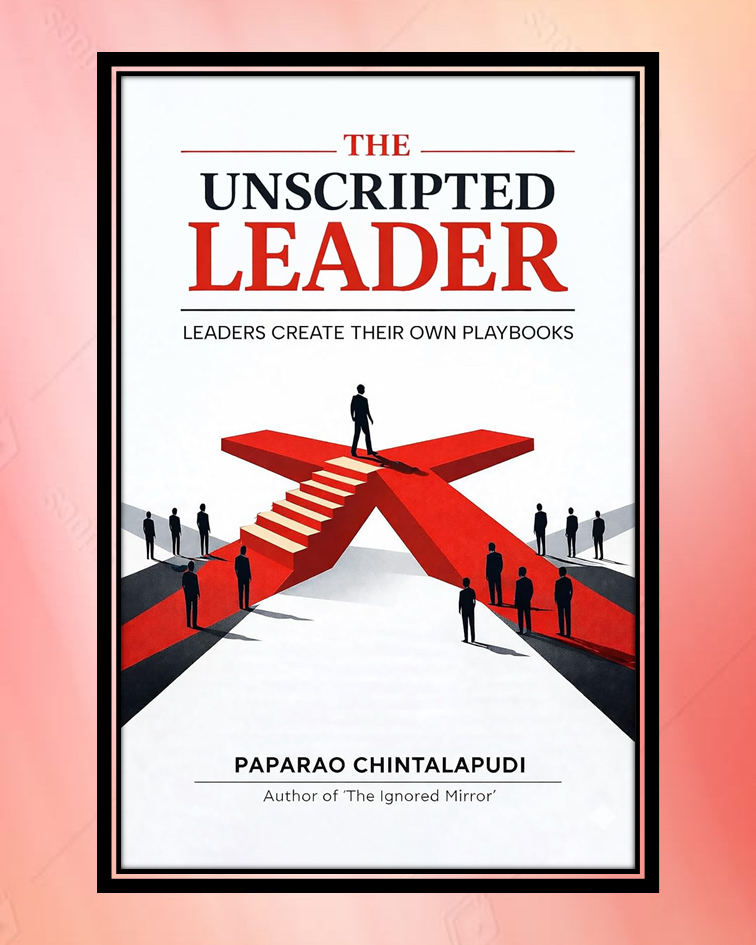
That’s the space I found myself in while reading The Unscripted Leader by Paparao Chintalapudi.
This isn’t the kind of book that tells you what to do.
It quietly shifts something more uncomfortable—how you think when there is no clear answer.
At one level, the premise feels familiar: leadership, decision-making, complexity. But very quickly, the narrative moves away from borrowed frameworks and polished global theories into something far more grounded—and honestly, far more relevant to our context. The book doesn’t pretend that leadership is linear. It treats it like what it actually is: a series of imperfect decisions taken under incomplete information.
And that honesty stays with you.
What stood out for me is the way the author builds around “judgment” rather than “skills.” That shift may sound subtle on paper, but while reading, it lands differently. Skills can be learned. Judgment has to be lived. And this book leans heavily into that discomfort.
The 4D Meta-Framework—though structured—never feels like a rigid model. It behaves more like a lens you keep adjusting. Self-leadership, systems thinking, organisational realities, strategy… they don’t sit in separate boxes. They overlap, interfere, sometimes even contradict each other. And that’s where the book becomes interesting.
Because it doesn’t resolve that tension for you.
It lets you sit with it.
There were moments while reading when I found myself pausing—not because the language was complex, but because the implication was. Especially during the case studies. These aren’t success stories designed to inspire. They’re situations that refuse to simplify themselves. Trade-offs that don’t have clean winners. Decisions that carry consequences beyond intent.
And somewhere in those pages, I caught myself reflecting not on leaders… but on my own decisions.
That, to me, is where the real impact lies.
The prose is controlled. Almost restrained. It doesn’t try to impress you with dramatic language or motivational highs. Instead, it observes. It explains just enough—and then steps back. That restraint works in its favor, especially for readers who prefer depth over noise.
But this also becomes a slight resistance point.
If you’re someone looking for quick takeaways or actionable checklists, this book might feel slow… even demanding. It asks for attention. Reflection. Sometimes even rereading. It’s not built for speed.
It’s built for absorption.
And that’s a choice.
Another thing I appreciated is how deeply rooted the narrative is in Indian realities. Not as a token inclusion—but as the core context. Whether it’s public institutions, enterprises, or systems that don’t behave predictably, the examples feel lived-in. Familiar, in a way that global leadership books often miss.
At one point, I caught myself thinking:
“This is not a book you finish. This is a book you return to.”
Because the first read gives you understanding.
But the second read might give you clarity.
In terms of strengths, the book excels in three areas. First, its refusal to oversimplify leadership. Second, its focus on judgment as a lived practice rather than a theoretical idea. And third, the way it uses real-world complexity instead of curated success narratives.
On the flip side, it does demand a certain maturity from the reader. This is not entry-level motivation. It assumes you’ve already experienced confusion, pressure, maybe even failure—and are now looking to make sense of it.
If you haven’t been there yet, parts of the book might not fully land.
But if you have… it hits differently.
I would recommend this to professionals who are at that transition point—where titles change faster than clarity does. Managers stepping into leadership roles. Founders navigating uncertainty. Anyone who has realised that decisions don’t come with instructions.
Not every book gives you answers.
Some books sharpen your questions.
And sometimes… that’s far more dangerous.
Because once you start seeing clearly—you can’t go back to comfortable assumptions.
If you’ve ever felt that quiet gap between knowing what to do… and understanding why it matters, this might be a book worth sitting with.
Not rushing through.
Just… sitting with.
#TheUnscriptedLeader #LeadershipInIndia #ReadingBetweenTheLines #BookReviewIndia #LeadershipJourney #SameerReads #ThinkAndReflect #IndianAuthors #BeyondManagement #ReadingCulture #Sameergudhate #thebookreviewman


Comments