


Sameer Gudhate Presents the Book Review of Shukriya Boganviliya by Nitya Shukla
I didn’t read Shukriya Boganviliya in one sitting.
Not because it was difficult—but because it kept asking me to stop.
A poem would end, and instead of turning the page, I would sit there, feeling oddly addressed. As if someone had spoken my name softly and walked away.
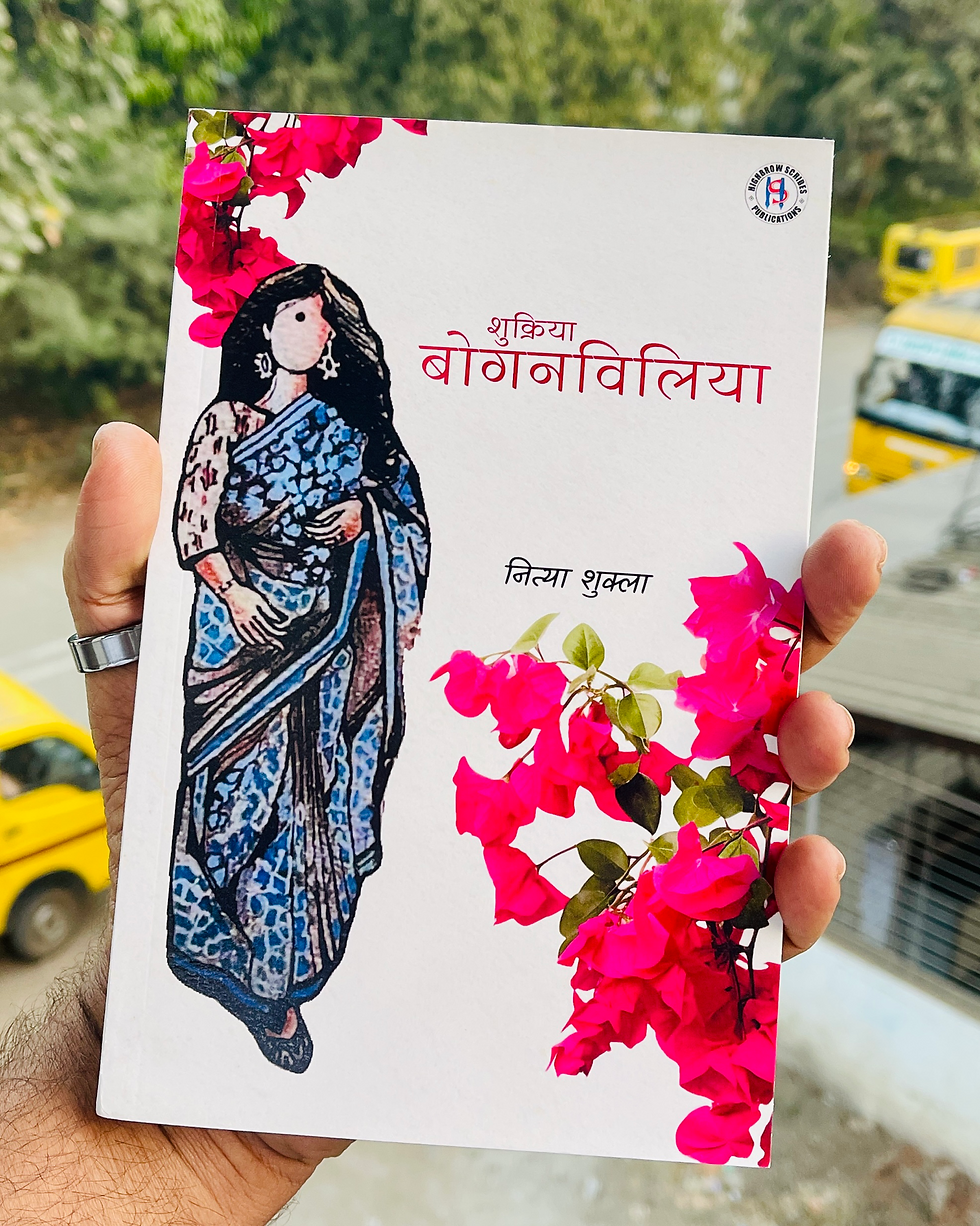
Written by Nitya Shukla, Shukriya Boganviliya is a Hindi poetry collection that doesn’t ask for attention. It earns it quietly. Published by Highbrow Scribes Publications, this book carries an unassuming confidence—like someone who knows they don’t need to raise their voice to be heard. If you’re looking for spectacle, this isn’t it. If you’re looking for truth, it just might sit beside you.
At its core, the book speaks about gratitude—not the kind written on greeting cards, but the kind that forms after endurance. Gratitude shaped by womanhood, by family, by memory, by the ordinary courage it takes to keep showing up. These poems are not about grand events. They are about what remains after the events are over. The emotional stakes are personal, not dramatic—and that makes them powerful.
Nitya Shukla’s writing style is restrained and deliberate. She trusts silence as much as words. The poems are paced gently, almost conversational, but never careless. You can sense a poet who knows exactly where to stop. There is rhythm here, but not performance. Lines feel lived-in. Images arrive without announcement—ankles heavy with jewellery, kitchens that hold unfinished dreams, fathers who express love without vocabulary. The language doesn’t decorate emotion; it reveals it.
What stayed with me most were the ideas—especially around womanhood and inheritance. Not inheritance as wealth, but as emotional lineage. The mother-daughter bond appears again and again, not sentimentalised, but understood. A mother’s role doesn’t end with biology; it seeps into everyday survival. A father’s presence is quiet, almost locked away, yet unmistakably solid. These poems don’t explain relationships. They observe them. And observation, when done honestly, can be radical.
Structurally, the collection flows like memory. There is no rigid arc, no insistence on climax. Some poems feel like open windows. Others like notes you find folded inside old books. The rhythm allows the reader to dip in and out, but rewards those who read slowly. This is not a book to rush through. It asks for pauses—and gives you reasons to take them.
The themes are universal: loneliness, resilience, love, waiting, gratitude, loss. But they are anchored in specificity. That is where the emotional weight comes from. Loneliness here is not emptiness—it is awareness. Love is not always fulfilment—it is patience. Separation is not only pain—it is also clarity. Reading this book, I kept thinking how rarely we allow poetry to be this honest without being loud.
Emotionally, my reading journey was uneven in the best way. Some poems landed instantly. Others returned to me later—while making tea, while staring at nothing in particular. There were moments that unsettled me, especially those that spoke about unfinished dreams and quiet compromises. There were moments that softened me too. The book didn’t break me open. It sat with me. And sometimes, that’s more difficult.
Among its strengths are emotional authenticity, imagery, and restraint. The poet never overreaches. If I had to offer a gentle critique, it would be that a few poems feel thematically close enough that I wished for a sharper contrast in placement. But that’s a minor quibble—like wishing for more space between flowers in a garden already blooming.
Personally, Shukriya Boganviliya aligns deeply with the kind of poetry I return to as a reader—poetry that doesn’t perform wisdom, but carries it quietly. If you enjoy reflective writing that honours everyday emotional labour, this book will speak to you. It will especially resonate with readers who believe poetry doesn’t need to shout to be remembered.
I closed the book slowly.
Not because I was finished—
but because I wanted the words
to finish speaking inside me.
If you’re willing to listen— really listen— Shukriya Boganviliya is waiting.
If you feel like wandering a little further:
– Another day in my reading journey: Tumhari Auqat Kya Hai by Piyush Mishra
– A book that caught my eye this time: His Last Note by Harshitha Rajala
– One from the past, still worth visiting: Sanatana & Science by Pankaj Lochan
#BookReview #PoetryLovers #HindiPoetry #IndianPoetry #PoetryThatHeals #WordsThatStay #QuietReads #ReflectiveReading #PoetryCommunity #ReadersOfInstagram #BooksThatTouch #LiteraryIndia #PoetryAsTruth #SameerGudhate #ReadingWithHeart #thebookreviewman


Comments